Stop Paying for Feelings.
Why compensation conversations break down when accountability isn’t clearly defined

Where Pay Conversations Quietly Go Off the Rails
There’s a moment that happens quietly inside a lot of property management companies, and once you notice it, you can’t unsee it.
It’s usually not dramatic. No one storms out. No one demands a raise. It shows up as a tone shift. A comment made half-jokingly. A comparison that lingers a little too long. Someone recalculating their value based on what they think someone else is getting.
“Must be nice.”
Must be nice to work from home.
Must be nice to get that bonus.
Must be nice not to have to be here 9 to 5.
I hear some version of this in almost every consulting engagement. Different markets. Different portfolio sizes. Different leadership styles. Same underlying tension.
And almost every time, leadership assumes it’s about entitlement or attitude. In reality, it’s almost always about confusion.
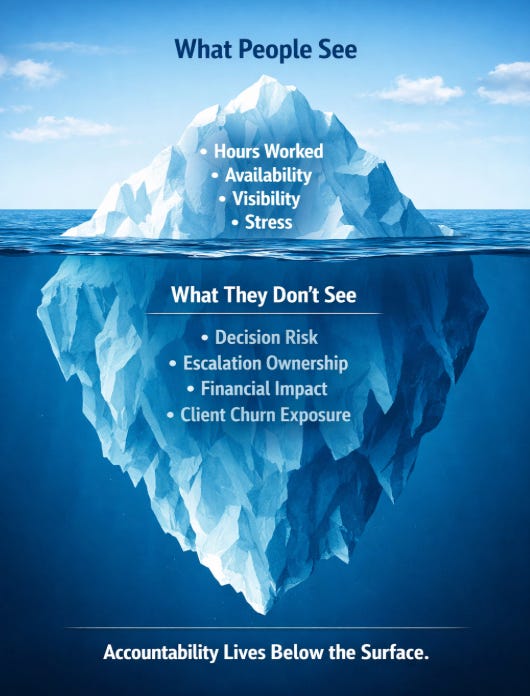
People are trying to make sense of compensation, titles, flexibility, and bonuses using the only information they can see. They see hours worked. They see availability. They see who’s pulled into which meetings. They see who gets flexibility and who doesn’t. What they don’t see is accountability.
When that distinction isn’t clearly articulated, people default to the most obvious metric they have: effort. How hard the year felt. How much stress they carried. How often they were overwhelmed. From a human standpoint, that makes complete sense.
But effort, by itself, is not what stabilizes a business.
Responsibility is.
Responsibility is who owns the outcome when an owner escalates.
Responsibility is who absorbs the risk when a decision goes sideways.
Responsibility is who carries the weight when something breaks and there’s nowhere to pass it.
Most roles in a property management company are not designed to carry that level of accountability, and they shouldn’t. That’s how healthy organizations function. But when leadership doesn’t make that distinction explicit, compensation starts to feel personal instead of professional.
This is where good intentions often make things worse.
Wanting to be fair, leaders soften decisions. Wanting to avoid resentment, they blur lines. Wanting to reward effort, they compensate based on how hard the year felt or how uncomfortable the conversation is instead of what the role actually owns.
Over time, the organization learns a quiet lesson: feelings matter more than responsibility.
Once that message takes hold, pay conversations stop being anchored in structure and start being governed by comparison. That’s not a people problem. It’s a clarity problem. And it’s one of the most expensive ones a property management company can have.
Why Transparency Without Structure Actually Makes This Worse
There’s a distinction that changes how all of this clicks into place, and most companies never fully define it.
Responsibility is the work someone is assigned.
Accountability is what they’re held to when the outcome isn’t what anyone hoped for.
Those two things are not the same, but compensation conversations often treat them as if they are. That’s where things start to unravel.
When pay tension starts building, I hear the same advice over and over: “We just need to be more transparent.” On the surface, that sounds reasonable. If people know more, surely things will feel fairer.
To be clear, I’m not advocating that employers share what everyone makes or start posting individual salaries for comparison. That rarely solves the problem people think it will solve. What actually helps is transparency around how compensation is structured, how roles are evaluated, and what someone is accountable for inside the business.
Because in practice, transparency without structure usually makes things worse, not better.
What often happens is that numbers get shared before the logic behind them is ever clearly articulated. Someone hears what another person makes. A bonus amount comes up casually. A salary range gets mentioned without any context for why roles differ. The intent is openness. The impact is comparison.
And once comparison enters the picture, emotion follows almost immediately.
People don’t compare accountability. They compare effort. They compare hours. They compare visibility. They compare what they can see from the outside, not what sits underneath the role when things go wrong.
I’ve watched this play out more times than I can count. A leader shares information hoping it will build trust, and instead it creates resentment that didn’t exist before. Suddenly a $100 difference in a bonus feels personal. A higher salary feels unjustified. Flexibility feels unfair. Not because the decisions were wrong, but because the structure behind them was never made clear.
From a behavioral perspective, this reaction is completely predictable. When people are given partial information, they don’t stop evaluating. They just evaluate with the wrong data. They fill in the gaps with assumptions, and those assumptions tend to skew toward unfairness, especially when people are already stretched thin.
This is where leaders often feel blindsided.
They know why a role is paid the way it is. They know who carries the weight when an owner is upset, when a resident threatens legal action, or when a portfolio starts bleeding doors. But that context lives in their head. It’s not written down. It’s not shared. It’s not consistently communicated.
So when transparency shows up before clarity, it doesn’t build trust. It exposes inconsistency.
Over time, I’ve learned that transparency only works after structure is in place. Without structure, it amplifies confusion instead of resolving it.
This is often the turning point in consulting work. The realization that the company doesn’t actually have a pay problem. It has a definition problem. Once accountability is clearly articulated, compensation decisions start to make sense, even when they’re not equal.
What Clarity Actually Looks Like in Practice
This is usually the moment when leaders nod along and still feel stuck.
Not because they disagree, but because the gap between “I get it” and “I know how to apply this” feels wide. Everyone understands, intellectually, that accountability matters more than effort. But translating that into real roles, real pay, and real incentives inside a live business is where things start to feel messy again.
This is often where people ask for benchmarks or industry averages or a clean formula that will make the discomfort go away.
There isn’t a universal answer. But there is a practical way to think about it that removes much of the emotion and replaces it with clarity.
It starts with accepting an uncomfortable truth: two roles can sit at the same “level” in a company and still be doing fundamentally different jobs.
Once you see that clearly, compensation stops being confusing and starts being explainable.
Same Level, Two Very Different Jobs
A Property Manager and a Maintenance Manager often look equal on an org chart. They both carry pressure. They both get blamed when things go sideways. They both manage outcomes that affect retention and revenue.
But they’re accountable to completely different scoreboards.
When leadership doesn’t make that visible, people fill in the gaps with assumptions. That’s how you end up with quiet resentment and “must be nice” culture. Not because anyone is malicious, but because no one explained the logic.
So instead of debating titles or feelings, it helps to make the structure visible.
Here’s a simple compensation framework that can actually be budgeted.
Using a $65,000 base salary as a consistent example, total variable compensation is capped at 10%. That’s $6,500 annually. Not guaranteed. Budgeted. Earned.
Half of that is tied to quarterly KPIs. The other half is tied to a year-end bonus. Same structure across roles. Different scoreboards.
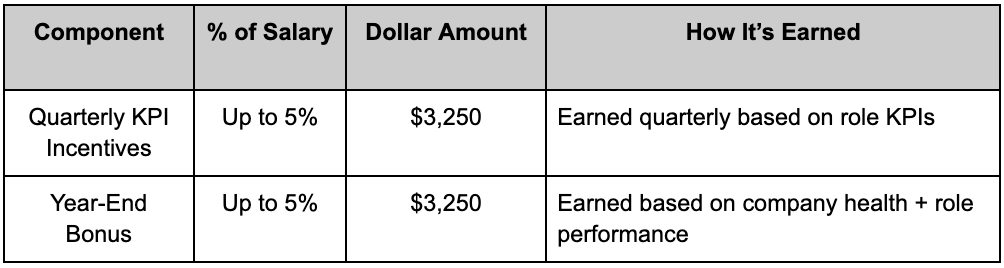
This one decision alone changes the tone of compensation conversations.
Pay is no longer emotional. It’s factual. You’re not “deciding” bonuses in December. You’re paying against a plan everyone understood in January.
Before we look at KPIs, there’s one distinction that matters.
Some KPIs are role-owned.
Some KPIs are shared.
It means multiple roles influence the outcome, but accountability still sits somewhere specific.
Owners don’t experience your company by department. They experience outcomes. Your incentive structure should reflect that reality.
Role Example 1: Property Manager
The Property Manager is the role owners experience as the business. That’s why PM accountability sits at the intersection of resident outcomes, owner confidence, and portfolio performance.
A PM doesn’t get to say “maintenance was behind” or “leasing dropped the ball.” Coordination is part of the job. Some KPIs are shared, but accountability still lives with the PM because owners experience results, not departments.
Typical quarterly KPIs for a PM might include Days on Market, renewal rate, and an owner satisfaction or retention signal. DOM is shared with leasing and maintenance, but it still reflects on the PM. Renewals stabilize revenue and workload. Owner satisfaction is the ultimate retention signal.
Quarterly incentives are earned, not assumed. Hit two out of three KPIs, earn a portion. Miss all three, earn nothing. Exceed targets, still capped. The budget stays disciplined.
At year end, the bonus is gated by company health first, then adjusted by full-year performance. A strong PM in a hard year may receive less than the maximum. That’s not punitive. It reinforces shared accountability.
Role Example 2: Maintenance Manager
Maintenance Managers often carry just as much pressure as PMs, but the scoreboard is different.
Their accountability is driven by speed, quality, cost control, and vendor performance. These factors determine how quickly a property crosses from tolerable to unacceptable.
Quarterly KPIs typically focus on work order SLAs, turn time and readiness accuracy, and margin or cost control depending on the business model. Weighting matters here. Speed and turns tend to carry more weight because that’s where chaos shows up first.
At year end, the same bonus structure applies. The difference is how performance is evaluated. Full-year trend improvement matters more than isolated wins. Repeat repairs, vendor compliance, and forecasting accuracy matter more than raw volume.
And one rule should never be violated: speed should never be rewarded if it creates more work later through callbacks, owner frustration, or margin erosion, that is not success.
Why This Matters
This isn’t really about bonuses.
It’s about trust.
Teams disengage when compensation feels arbitrary, not when it’s imperfect. When structure exists, people stop guessing. Comparisons still happen, but they’re less charged because the logic is visible.
Leadership stops managing by guilt. Year-end stops feeling like improvisation. Conversations become factual instead of emotional.
Fair does not mean equal. Equal means everyone gets the same.
Fair means compensation aligns with responsibility, accountability, and impact.
Property management companies don’t need equal. They need fair.
Let’s Continue the Conversation
Last week, I asked a series of questions about compensation, accountability, and people strategy, and the responses received so far confirmed what I see every day: these tensions are everywhere, and they’re rarely talked about openly.
I’m continuing to collect responses over the next five days to better understand where the biggest gaps actually are. The goal isn’t to arrive at a single answer. It’s to gather real data from people running these businesses and share what the patterns reveal.
If you haven’t already, I’d love for you to weigh in. The more perspectives we gather, the clearer the picture becomes.
Because avoiding this conversation won’t make it go away. It will just make it more expensive.